
‘Led Zeppelin IV': Ranking Every Song From a Career-Defining Album
Led Zeppelin's atmospheric, game-changing fourth album couldn't have been made any other way. Its actual name, however, remains a point of contention.
Sessions were primarily held inside a rural, rather spooky 18th-century estate in Hampshire, England. Something in the surroundings clearly provided a spark: Material recorded at Headley Grange appeared on the preceding studio project and subsequently on Houses of the Holy and Physical Graffiti, as well.
"We were all living in the same house," Jimmy Page later told Music Connection magazine, "and eating, sleeping and making the music and recording the music. There might even be some eating in the music, too. We had this sort of work ethic where we were all together, and the possibilities were limitless, really."
Ranking Every Song From 'Led Zeppelin IV'
The lead single, "Black Dog," became Led Zeppelin's highest-charting U.S. single. But these songs were most often heard together, as a continuous listening experience. The follow-up to Led Zeppelin III has been certified 24-times platinum since its arrival on Nov. 7, 1971.
"The fourth album showcases perfectly everything to do with the band, whether it's the individual performances or how it works collectively, the production and everything to do with it," Page told the Quietus. "It's a really strong time capsule. That's what it is and so different from the albums that came before."

Taking a break far away from fans and – more particularly – the sometimes still-dismissive media also allowed the members of Led Zeppelin to reflect on their burgeoning careers. "After all we had accomplished, the press was still calling us a hype," Page told Rolling Stone. "So, that is why the fourth album is untitled."
READ MORE: Ranking Every Led Zeppelin Album – No. 7 Might Surprise You
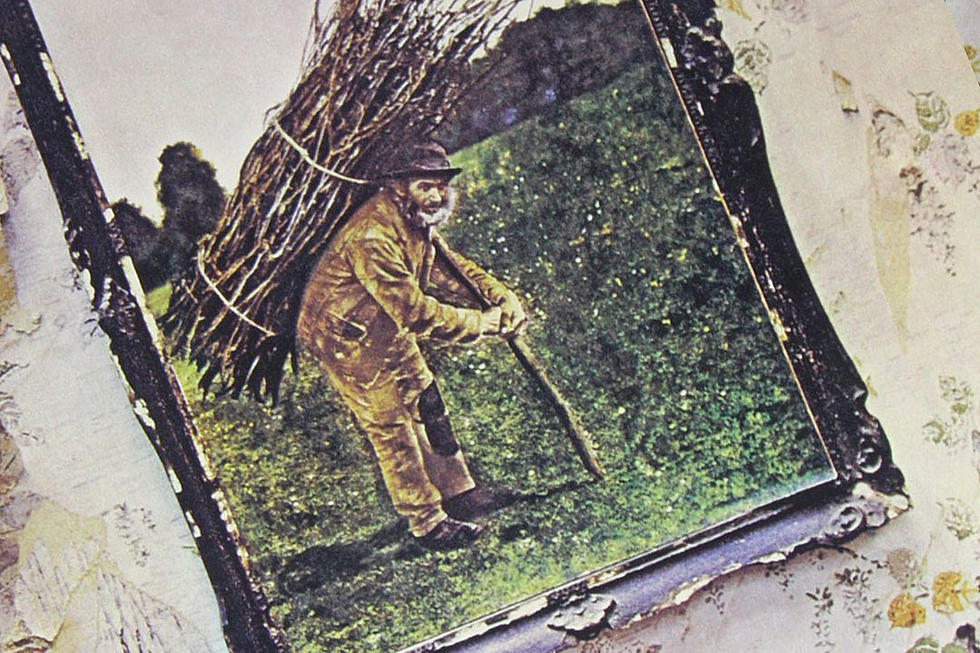
Page initially refused interviews. There'd be no further explanation. As the silence yawned to more than a year and a half, this LP came to be called many things: Untitled, of course, or Led Zeppelin IV because of its place in the band's discography. Others chose Zoso or Four Symbols, after runes on the cover that seemed to represent each member.
For Robert Plant, it was "just 'the fourth album.' That's it." He later admitted that he had no idea how anyone else should refer to the LP.
Listen to Led Zeppelin’s ‘Black Dog’ in Concert
What's the Best Song on 'Led Zeppelin IV'?
Led Zeppelin would move on, recording their late-career LPs Presence and In Through the Out Door in Munich and Stockholm, respectively. The drafty Headley Grange manor would not necessarily be missed by John Paul Jones.
"Headley Grange was cold, damp, dirty, smelly," he told Mojo. For Page, however, that was hardly a negative: "Headley was a bit austere, but there was no 'let's get stoned or go to the pub and get pissed.' That wasn't our raison d'etre. It was 'eat, sleep, work.'"
Whatever it was, as shown by the following ranked look back at Led Zeppelin IV songs, the group succeeded in a way they never had before – and rarely would again:
No. 8. "Four Sticks"
Led Zeppelin was stuck. Then John Bonham went to see a solo band performance by his hero, Ginger Baker of Blind Faith and Cream fame, at the Lyceum Theatre in London. Inspired, Bonham downed a beer and then picked up the titular handful of drumsticks. Jimmy Page could hardly believe the transformation.
"It's astonishing what he's doing. He'd never employed that style of playing before," Page said in Mick Wall's 2008 biography When Giants Walked the Earth. "I can't even remember what it was called, what the working title was. But it was sure as hell 'Four Sticks' after that. Bonzo just took it into another stratosphere."
They'd caught the equivalent of musical lightning in a bottle – and it's a good thing. "We just did two takes of it," Page confirmed, "because that's all we could sort of manage."
No. 7. "The Battle of Evermore"
Led Zeppelin IV came galloping out with "Black Dog" and "Rock and Roll," before downshifting into a mandolin-driven rumination on good vs. evil. Fans divined references to J.R.R. Tolkien, likely because Plant had referenced The Lord of the Rings during "Ramble On" from Led Zeppelin II. Plant said he was actually inspired by a book about the Scottish wars.
Either way, the song's moral dichotomy ultimately required a second voice. "You have two parts of the story," Plant explained on his Digging Deep podcast. "I started to write it so that you had a section A that told the story that would be a disaster, and I had a section B, which was the triumph and the rallying – and I tried to sing them both. And it was a very, very insane idea."
Plant turned to the late guest singer Sandy Denny, who'd shared a stage with Led Zeppelin as a member of Fairport Convention at 1970's Bath Festival of Blues and Progressive Music. Her performance, Plant argued, saved the song. "If it suffered from naivete and tweeness — I was only 23 — it makes up for it in the cohesion of the voices and the playing," he later told Uncut magazine.
READ MORE: Ranking All 92 Led Zeppelin Songs
No. 6. "Rock and Roll"
Attempts to complete "Four Sticks" had ground to a halt. Page had an idea: "If the track isn't happening and it starts creating a psychological barrier, even after an hour or two, then you should stop and do something else," he said in 2012's Light & Shade: Conversations With Jimmy Page. "Go to the pub or a restaurant or something – or play another song."
So, they did. Bonham played the opening rhythm from Little Richard's "Keep a Knockin,'" which inspired Page toward a Chuck Berry-type riff. As Jones and Plant joined in, Page said: "Stop. Let's work on this."
The resulting song, simply dubbed "Rock and Roll," didn't immediately fall into place. But this would become the A-side on the final single from Led Zeppelin IV, with "Four Sticks" as the B-side. "It actually ground to a halt after about 12 bars," Page later told the Trouser Press. "But it was enough to know that there was enough of a number there to keep working on it."
No. 5. "Going to California"
This was a passion project for Page and Plant. "When you're in love with Joni Mitchell," Plant supposedly quipped, "you've really got to write about it now and again." The result was "Going to California."
Their music was, of course, very different – as were their backgrounds. But both acts ultimately journeyed to the West Coast, from Canada and England, respectively, while forging their own divergent paths: Mitchell fell in immediately with the Laurel Canyon crowd, putting her inside the scary fault line that threatens to send a good portion of the state falling into the sea. Also, the Laurel Canyon folks hated Led Zeppelin.
So the band's admiration for Mitchell was largely long-distance. They spoke of her admiringly in the press, while their most direct connection remained this moment of touching pastoral beauty on Led Zeppelin IV in Mitchell's honor.
No. 4. "Misty Mountain Hop"
Beyond the sawing riffs and building-rattling stomps, there was always something a little hippie-dippie about Led Zeppelin. One critic memorably described lyrical detours like "Misty Mountain Hop" as "dated flower-child gibberish."
Robert Plant stood his ground, presumably in bell-bottoms: "The essence of the whole trip was the desire for peace and tranquility, and an idyllic situation," he later told Rolling Stone. "That's all anybody could ever want. So, how could it be 'dated flower-child gibberish'? If it is, then I'll just carry on being a dated flower child."
"Misty Mountain Hop" managed to unapologetically combine all three of these basic elements – the stomps, for sure, and the sawing riff and (most certainly) the hippie-dippie stuff.
No. 3. "When the Levee Breaks"
Led Zeppelin always had a connection with deep blues. Thankfully, by the time they returned to this passion on Led Zeppelin IV, they'd also learned to properly credit their inspirations. Memphis Minnie was listed as a co-writer on the album-closing "When the Levee Breaks," even as the final recording roved far afield from her original '20s-era recording with Kansas Joe McCoy.
It's still a dark rumination on the Great Mississippi Flood of 1927, as hundreds were killed and thousands were displaced. (Levees disintegrated in more than 100 locations along the river, releasing depths of muddy water measuring as much as 30 feet.) But Led Zeppelin surrounded it all with music that mirrored the expanded lyric's swirling, slow-building menace.
The results were suffocating, yet also deeply enthralling. "The whole idea was to make [the song] into a trance," Page said in Light & Shade: Conversations With Jimmy Page. "If you notice, something new is added to every verse. Check it out — the phasing of the voice changes, lots of backward stuff is added and, at the end, everything starts moving around except the vocal, which stays stationary."
READ MORE: Top 10 Most Head-Scratching Led Zeppelin Lyrics
No. 2. "Black Dog"
The opening track on Led Zeppelin's untitled fourth album is as tough as it is rangy. "I wanted to try an electric blues with a rolling bass part – but it couldn't be too simple," Jones said in 2015's Whole Lotta Led Zeppelin. Well, mission accomplished.
That nervy musical foundation – "I wanted it to turn back on itself," Jones added – created a remarkable challenge in the studio. The shifting time signature can become maze-like, especially "the bit where it goes into sort of triplets in one part and overlaps," as Page admitted to SiriusXM. John Bonham finally completed his part by simply bullying through the turnaround with a determined four-time rhythm.
The final lyric came much easier. Page devised a call-and-response vocal approach inspired by Fleetwood Mac's Top 5 1969 U.K. hit "Oh Well (Pt. 1)," then Plant began reeling off lusty, tried-and-true blues-isms. Later, a stray Labrador who kept hanging around Headley Grange provided the non sequitur title.
No. 1. "Stairway to Heaven"
In a twist, "Stairway to Heaven" only began to assume its final form once Plant had completed the narrative. Page's musical ambitions, to that point, had simply made the thing too unwieldy. "The idea was to have a song which would actually change as we went through it," Page told Music Connection. "I knew something like that wasn't necessarily the done thing in popular music. It was done in classical music."
Next came a bustle in the hedgerow. "Then it came together, really," Page added. "The performances of it were more complete once it had the lyrics there, but it gave us the opportunity to really build something and shape it to perfection." Yet the creators of "Stairway to Heaven" are still wrestling with its legacy.
Plant thinks this song now "belongs to a particular time," while arguing that "Kashmir" better represents Led Zeppelin's particular genius. (Plant also quite hilariously offered $10,000 to a radio station in Portland, Oregon, if they'd never play "Stairway to Heaven" again.) For Page, however, this moment "crystallized the essence of the band." We tend to agree.
Denis Leary Doesn't Understand Why Led Zeppelin Won't Reunite
Ranking Every Led Zeppelin Live Album
Gallery Credit: Nick DeRiso
Listen to Kevin Shirley on the 'UCR Podcast'
